



Light Duty vs. Heavy Duty Trucks: How to Choose the Right One for Your Business
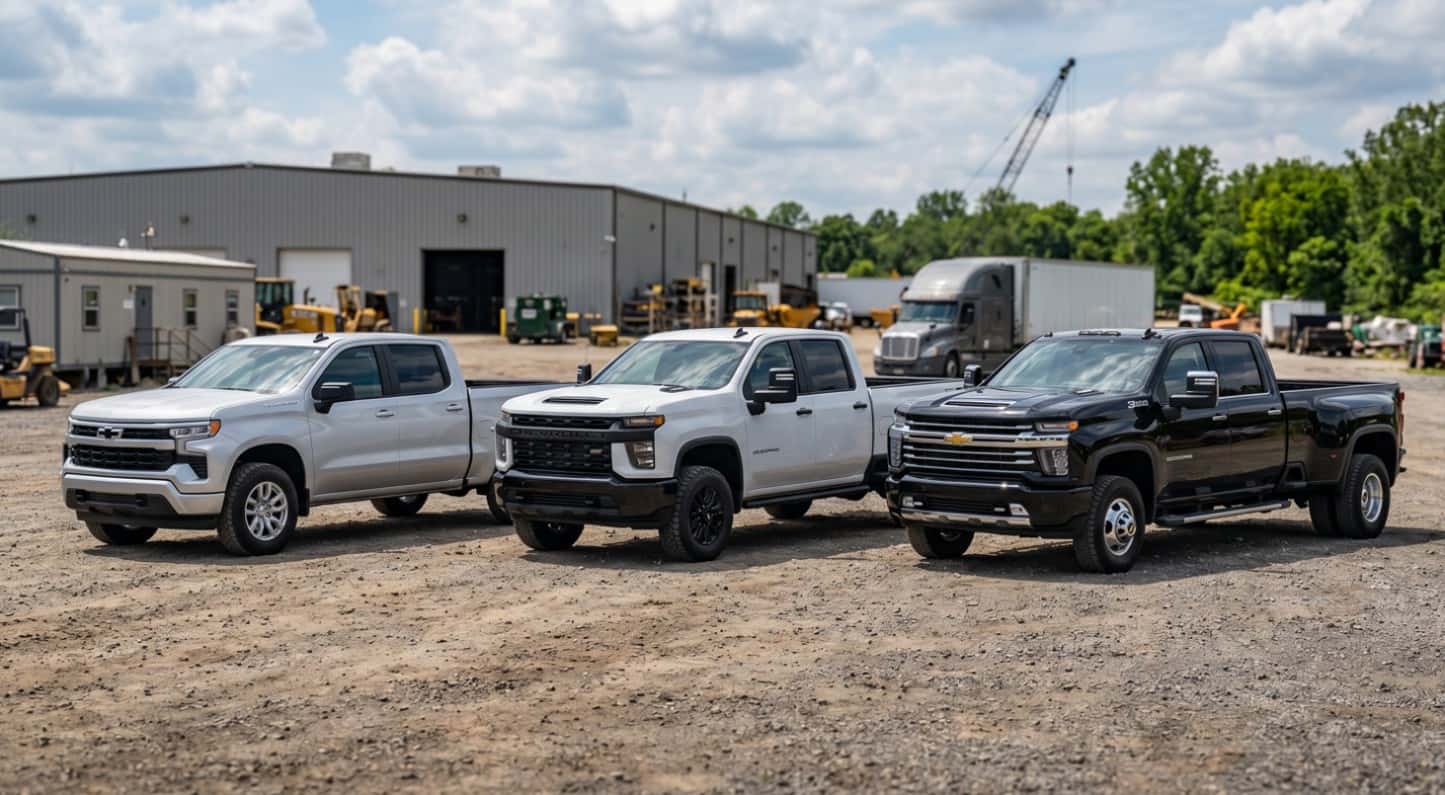
At first glance, the 2026 Chevrolet Silverado 1500, 2500HD, and 3500HD look like three versions of the same truck. They share styling cues, similar interiors, and many of the same features. But under the skin, these are very different machines built for very different jobs. Choosing the wrong one can mean either spending money on capability you’ll never use — or, worse, asking a truck to do work it wasn’t built for. Here’s how to think about the choice.
What “Light Duty” and “Heavy Duty” Actually Mean
In Chevrolet’s lineup, the Silverado 1500 is the light-duty truck. The Silverado 2500HD and 3500HD are heavy-duty (“HD”) trucks. The difference isn’t marketing — it’s structural. Heavy-duty trucks use beefier frames, stronger axles, larger brakes, upgraded suspensions, and powertrains designed to handle sustained loads that would overwhelm a light-duty truck.
The federal weight class system also separates them: light-duty trucks fall into Class 2a, while the Silverado 2500HD and 3500HD typically fall into Class 2b and Class 3. That classification affects everything from licensing requirements to insurance to which trailers and equipment the truck can legally pull.
The Silverado 1500: Versatile and Capable
The 2026 Silverado 1500 is the right truck for an enormous range of business and personal applications. When properly equipped, it can tow up to 13,300 pounds and carry up to 2,260 pounds of payload — strong numbers that handle most everyday business needs.
The 1500 is built for:
- Daily driving with light to moderate payloads
- Towing standard travel trailers, boats, landscaping trailers, and smaller equipment trailers
- Crews moving tools, supplies, and modest equipment between job sites
- Service businesses where the truck spends most of its time as transportation, not as a load-hauler
- Mixed-use applications — a truck that has to be a work vehicle during the week and a family vehicle on weekends
Engine options range from the efficient 2.7L TurboMax to the powerful 6.2L V8 and the available 3.0L Duramax Turbo-Diesel, which delivers an excellent balance of towing capability and fuel economy.
The Silverado 2500HD: Serious Capability with Daily Drivability
Step up to the 2026 Silverado 2500HD and you’re in genuine heavy-duty territory. The 2500HD offers towing capacities up to roughly 20,000 pounds with the available Duramax 6.6L turbo-diesel, and payload up to 3,979 pounds. It comes in a single-rear-wheel (SRW) configuration that’s significantly more capable than the 1500 but still narrow enough to drive comfortably in everyday traffic.
The 2500HD is built for:
- Towing larger travel trailers, fifth wheels, and goosenecks
- Hauling heavier equipment trailers — skid steers, tractors, mini excavators
- Service businesses with utility bodies, dump bodies, or upfitted service trucks
- Contractors, landscapers, and excavation crews who tow and haul daily
- Towing horse trailers, livestock trailers, and large recreational trailers
Both heavy-duty Silverados share the same powertrains — the standard 6.6L gasoline V8 and the available Duramax 6.6L turbo-diesel mated to an Allison 10-speed automatic. Choosing between gas and diesel is its own conversation, and one our commercial team is happy to walk you through.
The Silverado 3500HD: Maximum Capability
When you need to haul or tow at the absolute upper end of what a pickup can do, the 2026 Silverado 3500HD is what you’re looking for. Properly equipped, the 3500HD can tow up to 36,000 pounds and carry up to 7,442 pounds of payload — numbers that reach into commercial truck territory.
The 3500HD’s defining feature is its available dual-rear-wheel (DRW) configuration, often called a “dually.” Dual rear wheels dramatically increase rear axle weight capacity, add stability under extreme loads, and unlock the highest tow and payload ratings in the Silverado lineup. The 3500HD is offered in both SRW and DRW; the SRW is more maneuverable, while the DRW is the workhorse.
The 3500HD is built for:
- Pulling large fifth wheels, goosenecks, and commercial trailers near the upper end of pickup capability
- Hauling heavy commercial equipment — large compressors, generators, equipment trailers, livestock loads
- Service bodies, utility beds, dump beds, flat beds, and other heavy upfits
- Businesses where the truck is the work — not transportation to and from the work
- Fleets where towing and payload demands push past what a 2500HD can comfortably handle
The Truth: Both HDs Share the Same Engine
Here’s something many shoppers don’t realize: the 2500HD and 3500HD use the same engines. You’re not gaining horsepower or torque by stepping up to the 3500HD. What you’re gaining is stronger structure — a more robust frame, heavier-duty axles, beefier suspension, and (when equipped) those dual rear wheels. If you don’t need the extra payload or towing capacity, the 2500HD does the same engine work in a more daily-friendly package.
How to Choose: A Practical Framework
Three questions will get most buyers most of the way to the right answer:
- What’s the heaviest load you’ll regularly carry or tow? Pick the truck that handles your heaviest realistic day with margin to spare — not the truck that just barely makes the spec on paper. Operating at the edge of a truck’s capability shortens its life and adds risk.
- How will the truck be used between heavy days? If 80% of days are routine driving and 20% are heavy hauling, you may want to size for the daily use and rent or sub-out the heaviest jobs. If every day is heavy, oversize.
- Will the truck be upfitted? Service bodies, utility beds, dump bodies, lift gates, and other upfits add significant weight — sometimes thousands of pounds. Your payload spec needs to support both the upfit and the cargo it carries.
Common Mistakes Business Owners Make
- Buying too small. Trying to make a 1500 do 2500HD work is hard on the truck and short on capability when it matters.
- Buying too big. Buying a 3500HD dually for a service business that mostly moves tools wastes money on capability that never gets used — plus higher insurance, fuel, and tires.
- Ignoring payload after upfitting. Adding a heavy service body or dump body to an undersized truck can put it over GVWR before it even leaves the shop.
- Choosing gas when diesel makes sense (or vice versa). High-mileage haulers usually pencil out better with diesel; light-use trucks often don’t.
- Not accounting for trailer tongue weight. Tongue weight (typically 10–15% of trailer weight) counts against the truck’s payload — not just its tow rating.
How Bachman Commercial Helps You Decide
Our commercial team doesn’t just sell trucks — we help match the right truck to the right job. We’ll talk through your typical loads, your peak loads, your upfit needs, your duty cycle, and your budget, and we’ll point you to the configuration that fits. We work with upfitters across the region for service bodies, dump bodies, utility beds, flatbeds, and specialty equipment. And we keep working with you after the sale: priority service scheduling, fleet pricing, and a service team that knows your trucks.
Ready to Find the Right Truck?
Whether you’re replacing a single truck or building out a fleet, the team at Bachman Commercial in Louisville is ready to help. Call or stop by to start a conversation — we’ll walk through your needs honestly and help you spec the truck that’ll earn its keep for years to come.
Frequently Asked Questions
What’s the difference between a Silverado 1500 and a 2500HD?
The 1500 is a light-duty truck designed for daily driving with moderate towing and payload. The 2500HD is a heavy-duty truck with a stronger frame, larger brakes, heavier-duty axles, and significantly higher towing and payload capacities — designed for sustained heavy work.
How much can a 2026 Silverado 1500 tow?
When properly equipped, the 2026 Silverado 1500 can tow up to 13,300 pounds. Maximum payload reaches up to about 2,260 pounds depending on configuration.
How much can a 2026 Silverado 2500HD tow?
Properly equipped, the 2026 Silverado 2500HD can tow up to 18,500 pounds with the 6.6L gasoline V8 and up to 20,000 pounds with the available Duramax 6.6L turbo-diesel. Maximum payload reaches up to 3,979 pounds.
How much can a 2026 Silverado 3500HD tow?
When properly equipped, the 2026 Silverado 3500HD can tow up to 36,000 pounds, and carry up to 7,442 pounds of payload — reaching its highest specs with the dual-rear-wheel configuration.
Do the 2500HD and 3500HD have the same engine?
Yes. Both heavy-duty trucks share the same 6.6L gasoline V8 and available 6.6L Duramax turbo-diesel paired with an Allison 10-speed automatic transmission. The difference between the two is in chassis strength, axle rating, suspension, and the available dual-rear-wheel configuration on the 3500HD.
Do I need a CDL to drive a Silverado HD?
For most non-commercial use, no. A standard driver’s license is generally sufficient. However, when towing heavy trailers or operating in certain commercial capacities, CDL requirements may apply based on the combined gross weight and how the vehicle is being used. Verify with your state and the FMCSA for your specific situation.
Is a diesel worth it for a work truck?
For high-mileage trucks, frequent heavy towing, and long-distance hauling, diesel often pays off in fuel economy, torque, and longevity. For light-duty work and lower annual mileage, the higher upfront cost and additional maintenance complexity may not pencil out. Our commercial team is happy to run the numbers with you.
0 comment(s) so far on Light Duty vs. Heavy Duty Trucks: How to Choose the Right One for Your Business