



Why Preventive Maintenance Matters More for Commercial Vehicles
For most personal vehicle owners, missing an oil change by a few hundred miles is no big deal. For a business, it can be the difference between a productive workday and a service truck stuck on the side of I-264 while a customer waits. Commercial vehicles work harder, log more miles, and carry more responsibility than the vehicles in your driveway at home — and that means preventive maintenance isn’t just smart, it’s essential to running a profitable business. Here’s why.
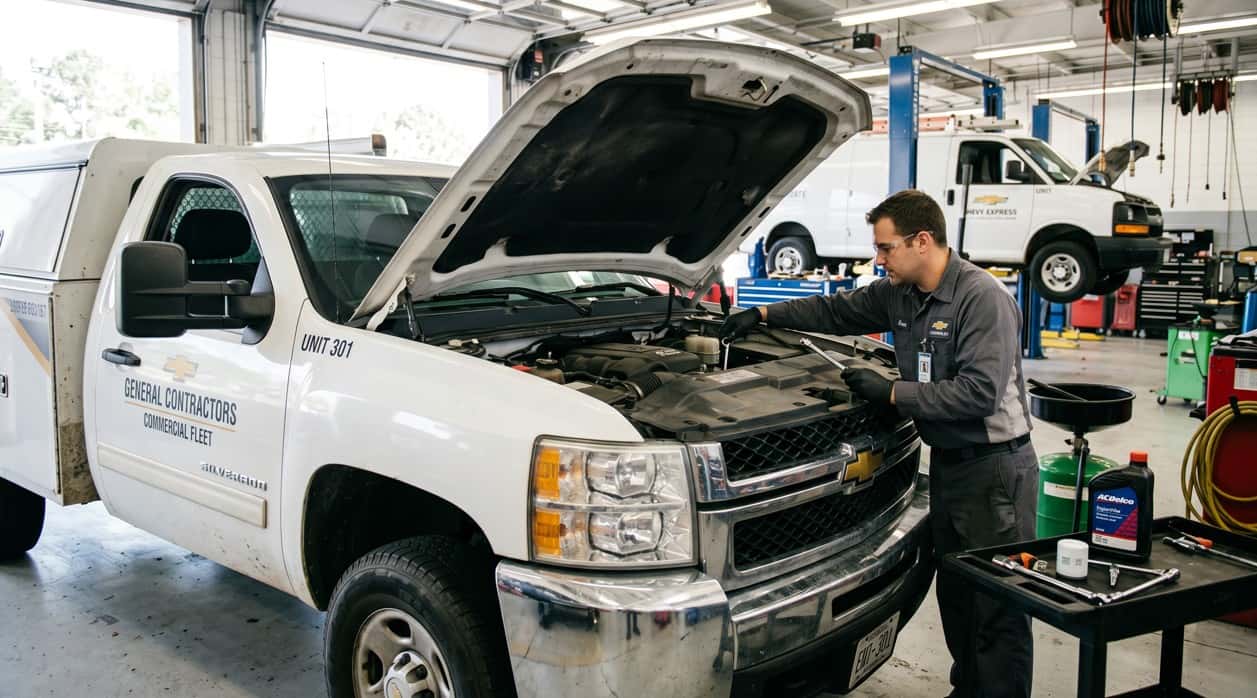
Downtime Costs More Than the Repair
When a commercial vehicle goes down, the repair bill is rarely the biggest cost. The real expense is everything that happens around it:
- Missed service appointments and lost revenue
- Rescheduling customers and the goodwill cost that comes with it
- Paying drivers and crews who can’t work
- Renting a temporary replacement vehicle
- Overtime to catch up after the vehicle is back in service
For a service business billing $150 an hour, even a single day of downtime can cost more than the maintenance that would have prevented it. Preventive maintenance flips the math: small, scheduled expenses replace big, unexpected ones.
Commercial Vehicles Work Harder Than Personal Vehicles
A plumber’s service van might cover 30,000 miles a year. A delivery truck can do double that. Even a contractor’s pickup gets used differently than a family’s daily driver — stop-and-go traffic, heavy payloads, towing, idling on job sites, and constant accessory load all add up.
The maintenance intervals printed in the owner’s manual assume “normal” driving. Most commercial use qualifies as “severe” service — the column most owners never look at — which calls for more frequent oil changes, filter replacements, brake inspections, and fluid services. Following severe-duty intervals isn’t paranoia. It’s realistic.
What a Preventive Maintenance Program Actually Looks Like
A good commercial PM program is more than “change the oil every few months.” It typically includes scheduled services across several categories:
- Engine maintenance — Oil and filter changes, air filter, fuel filter (especially on diesels), coolant service, belts and hoses.
- Drivetrain — Transmission fluid, transfer case (on 4WD), differential service, driveline lubrication.
- Brakes — Regular pad and rotor inspections, brake fluid flushes, parking brake checks. Commercial vehicles eat brakes faster, especially when loaded.
- Tires — Rotation, pressure checks, alignment, tread depth monitoring. Heavily loaded vehicles wear tires unevenly without consistent attention.
- Cooling system — Coolant condition, hose integrity, radiator condition, water pump inspection.
- Electrical — Battery testing, terminal cleaning, alternator output, starter performance, lighting inspection (essential for DOT compliance).
- Suspension and steering — Inspection of bushings, ball joints, tie rod ends, shocks — all of which see heavy use under load.
- Diesel-specific services — DEF system, EGR system, DPF regeneration health, fuel system service, and turbocharger inspection where applicable.
Diesel Trucks Need Extra Attention
If your fleet includes a Duramax-equipped Silverado HD or another diesel work truck, you already know diesels have unique maintenance needs. DPF (Diesel Particulate Filter) health, DEF (Diesel Exhaust Fluid) system function, fuel filter changes, and proper coolant maintenance all matter more on a diesel than on a gas engine. Skipping them doesn’t just shorten the engine’s life — it can trigger derate modes that limit power until a problem is corrected, leaving the truck barely usable until it’s in the shop.
Resale Value: The Maintenance Dividend
Businesses that cycle their vehicles every few years often discover that consistent maintenance pays a second dividend on the back end. Trucks and vans with documented service history command meaningfully higher resale and trade-in values. Buyers — whether your next owner or your dealer’s used vehicle manager — pay more for vehicles with a clear paper trail of consistent care. Skipping maintenance might save a few hundred dollars now and cost a few thousand at trade-in time.
Compliance Matters Too
Depending on what your vehicles are doing and how they’re classified, you may have DOT inspection requirements, IFTA reporting, or commercial insurance documentation that depends on regular maintenance and inspection records. A documented preventive maintenance program isn’t just operationally smart — it can be a regulatory necessity, and it’s often the easiest record-keeping habit to build.
Building a PM Schedule That Actually Sticks
The best maintenance program is the one your team actually follows. A few principles that work:
- Schedule by miles or hours, not the calendar. A van that runs 60,000 miles a year shouldn’t be on the same schedule as one that runs 12,000.
- Centralize records. Paper logs, fleet software, or even a shared spreadsheet — anything is better than nothing. Service history is only useful if you can find it.
- Pre-trip inspections. Train drivers to do basic walk-arounds: tires, lights, fluid leaks, anything obviously off. Catching small problems early is the easiest cost savings in the business.
- Standardize across the fleet. A common vehicle platform means common service intervals, shared parts, and predictable costs.
- Build relationships with your service team. A service writer who knows your fleet can flag emerging issues before they become breakdowns.
How Bachman Commercial Supports Your Fleet
Our commercial service team is built to handle business customers differently than the retail bay. We offer priority scheduling, dedicated commercial service writers who know your fleet, expedited turnaround, fleet pricing on parts and labor, and direct communication with your operations team so you’re never waiting on a callback. Whether you’re running a single service van or a fleet of work trucks, we’ll build a maintenance program that fits your business and your budget — and we’ll do the legwork to keep your vehicles working when you need them most.
Let’s Talk About Your Fleet
If your current maintenance approach is reactive rather than proactive, you’re probably leaving money and uptime on the table. Reach out to Bachman Commercial in Louisville to set up a conversation with our commercial team. We’ll review what you’re running, where you’re experiencing pain, and put together a preventive maintenance plan that keeps your vehicles — and your business — moving forward.
Frequently Asked Questions
How often should commercial vehicles be serviced?
Most commercial use qualifies as “severe service” under the manufacturer’s guidelines, which calls for more frequent oil changes, filter replacements, and fluid services than the standard schedule. The exact intervals depend on the vehicle, the duty cycle, and whether it’s gas or diesel — our commercial service team can build a schedule tailored to your fleet.
Is severe service maintenance really necessary?
For most commercial applications, yes. Stop-and-go driving, heavy payloads, towing, idling, and short trips all increase wear on engines, transmissions, and brakes. Following severe-duty intervals is realistic for how the vehicle is actually being used.
What’s the real cost of downtime for a service business?
It depends on your industry, but for many service businesses, a single day of downtime costs more than the entire annual maintenance budget for the vehicle. When you add lost revenue, payroll for idle workers, rescheduling costs, and customer goodwill, even routine breakdowns add up fast.
Do diesel trucks really need different maintenance?
Yes. Diesels have additional systems — DEF, DPF, EGR, more complex fuel filtration — that gas engines don’t. Skipping diesel-specific maintenance can trigger derate modes that limit power, leading to expensive repairs and significant downtime.
Does Bachman offer fleet service plans?
Yes. Our commercial service team offers priority scheduling, fleet pricing, dedicated commercial service writers, and customized maintenance programs sized to your business — from a single work truck to a multi-vehicle fleet.
Will good maintenance records affect my trade-in value?
Significantly. Vehicles with documented service history consistently appraise higher at trade-in and resale time. The cost of building and maintaining service records is small; the value at trade-in is meaningful.
0 comment(s) so far on Why Preventive Maintenance Matters More for Commercial Vehicles